


Knowing how to sex chickens really comes down to a few key approaches. You can look at the wing feathers of certain day-old chicks, keep an eye out for tell-tale developmental and behavioural clues as they grow, or, if you’re a professional, perform vent sexing. For most of us with a flock in the back garden, observing your birds and feather sexing are by far the most practical and accessible ways to tell the lads from the lasses.
Why Knowing Your Hens from Cockerels Matters
For any poultry keeper in the UK, whether you have a small backyard setup or a more ambitious flock, figuring out who’s a hen and who’s a cockerel is a fundamental skill. It’s about much more than just satisfying your curiosity; it’s a vital part of managing your flock well, and it affects everything from your morning egg basket to peace with your neighbours.
At its heart, knowing the ratio of pullets (young females) to cockerels (young males) helps you shape your flock for whatever your goal is. If you’re dreaming of a steady supply of fresh eggs, you’ll want a flock made up almost entirely of hens. If you accidentally raise a half-dozen cockerels, you’ve spent valuable time, feed, and effort on birds that will never lay a single egg.
Planning for a Balanced and Happy Flock
A balanced flock is a happy flock. Too many cockerels often leads to a stressed-out, bullied group of hens who can get injured from over-mating. It can also cause a lot of squabbling between the males themselves as they jostle for the top spot. Identifying and separating extra cockerels early helps keep a harmonious environment for everyone.
On top of that, local council regulations are a serious point for UK keepers to consider. Many urban and suburban areas have strict rules about noise, and a crowing cockerel is the quickest way to find yourself in your neighbours’ bad books. Knowing which of your fluffy chicks will grow up to have a powerful crow allows you to make responsible choices about rehoming them before they become a problem. These practicalities really bring home why learning to sex your chickens is so important.
If you’re interested in the entire journey from egg to chick, our guide on how to incubate chicken eggs at home covers all the detailed steps.
“The ability to accurately determine the sex of chicks is not just a backyard skill but a highly specialised profession. In fact, it’s a role with a significant expert shortage in the commercial poultry industry.”
That isn’t an exaggeration. The UK has genuinely faced a shortage of professional chick sexers, a job so specialised that starting salaries can be around £40,000. This high value just shows the huge economic importance of getting it right on a commercial scale, a fact you can read more about in this report on the crisis in British chicken sexing from The Independent.
Your Roadmap to Sexing Chickens
Luckily, you don’t need to be a salaried pro to get a pretty good idea of your flock’s makeup. Before we get into the details, here’s a quick overview of the methods people use.
Chicken Sexing Methods At a Glance
This table gives you a quick summary of the main chicken sexing methods, their reliability, and the best time to use them, giving you an immediate reference.
| Method | Best For | Typical Accuracy | Best Age to Perform |
|---|---|---|---|
| Feather Sexing | Specific hybrid breeds (sex-links) | 90-99% | Day-old |
| Observational | All breeds | 75-90% (varies) | 4-12 weeks |
| Vent Sexing | Professionals & hatcheries | 95-99% | Day-old |
| DNA Sexing | Rare or valuable breeds | 99.9% | Any age (from egg or feather) |
As you can see, the right method often depends on the age and breed of your chickens.
Throughout this guide, we’re going to demystify the techniques available to hobbyists and backyard keepers. We’ll cover:
- Feather Sexing: A handy trick for specific day-old hybrid chicks.
- Observational Sexing: The art of watching for developing physical and behavioural traits.
- Vent Sexing: An expert-level method we’ll explain but strongly advise novices to avoid.
Our goal is to arm you with the confidence and practical knowledge to tackle this task, helping you sidestep common mistakes and make the best decisions for a happy, thriving flock.
Feather Sexing Your Day-Old Chicks
For anyone just getting their hands dirty with poultry, feather sexing is often the first, and most approachable, method you’ll come across. It’s a world away from vent sexing, which honestly takes years to master. Instead, this technique is all about simple genetics and visual clues that you can pick up surprisingly quickly, especially with certain day-old chicks like sex-link hybrids.
The trick to feather sexing is all in the timing. You have a very short window—the first 24-48 hours after hatching—to see the differences clearly. These feather patterns actually develop while the chick is still inside the egg, a fascinating process you can read more about in our guide on the stages of chicken egg development. Once the chick hatches, these differences are as plain as day, if you know what you’re looking for.
Understanding the Feather Cues
When you gently fan out a chick’s tiny wing, you’ll notice two distinct rows of feathers. These are the primary feathers (the longer ones on the very edge) and the covert feathers (the shorter row just inside them). The relationship between these two rows is what gives the game away.
- Pullets (Females): A little hen will have two different feather lengths. You’ll see her primary feathers are quite a bit longer than her covert feathers. This creates a staggered, uneven look along the edge of her wing.
- Cockerels (Males): The boys are much tidier. A male chick will have feathers that are all pretty much the same length. His primary and covert feathers will be almost identical, giving his wing a neat, uniform edge.
To get a good look, just hold the chick gently but firmly in your palm. Then, use your thumb and forefinger to carefully spread one of its wings. Good lighting is essential here, as you’re looking at very fine details. The key is to stay calm and gentle; the last thing you want is a stressed-out chick.
Expert Tip: This whole method hinges on a specific genetic cross. It works because of a slow-feathering gene passed from the mother to her male chicks and a fast-feathering gene from the father to his female chicks. This is precisely what makes sex-link birds so special and a breeze to sex right out of the shell.
Which Breeds Can Be Feather Sexed?
Now for the most important bit: this technique only works for specific sex-link hybrids. These are chickens that have been intentionally bred for this very trait. Think of breeds like Black Stars, Red Stars, or ISA Browns. If you get these from a reputable hatchery, you can expect a feather-sexing accuracy of 90-99%.
On the flip side, you absolutely cannot use this method for most purebred chickens. Your Orpingtons, Wyandottes, or Leghorns simply don’t have the right genetics for it. Their feathers all grow at the same rate, regardless of sex. Trying to feather-sex a purebred is a classic beginner’s mistake that almost always leads to getting it wrong.
The whole business of sexing chicks has a fascinating backstory, by the way. It became a seriously big deal in the UK back in the 1930s, thanks to a collaboration with Japanese experts. This knowledge sharing, which began in a Yorkshire hatchery, completely changed the game for the British poultry industry. You can read more about the history and lucrative art of chicken sexing over at PSmag.com. So, before you start inspecting wings, always double-check that your breed is a sex-link.
An Honest Look at Vent Sexing
Sooner or later, anyone learning how to sex their chickens will run into the term vent sexing. This is the go-to method for commercial hatcheries, where trained professionals can sort chicks with incredible speed and an accuracy rate that often tops 95%. But for the backyard keeper or hobbyist, this is one of those areas where a bit of curiosity can do a lot of harm.

Vent sexing isn’t just a quick look. It involves carefully and very gently everting the chick’s cloaca—that single opening for everything—to get a glimpse of the internal structures. The whole point is to spot a tiny male reproductive organ, sometimes called the “bead” or “eminence,” which is missing in females. And when I say tiny, I mean it. We’re talking about something smaller than a pinhead.
A Skill That Takes Years to Master
The combination of immense pressure and a feather-light touch needed for vent sexing is a skill that takes years of dedicated, hands-on practice. A professional might handle thousands of chicks every single day, slowly building the muscle memory and feel required to do it safely. For an untrained hand, the risk of getting it wrong is just too high.
A simple mistake can lead to devastating consequences for the chick:
- Internal injury: It’s incredibly easy to damage the delicate tissues inside the cloaca.
- Paralysis: Handling the chick incorrectly can cause permanent injury to its spine.
- Death: What seems like a minor slip can be fatal to such a fragile little bird.
Trying this without proper training is a bit like attempting delicate surgery after watching a video about it. The potential for doing serious harm massively outweighs any benefit for someone with a small flock.
This isn’t a technique you can pick up from a blog post or a quick online tutorial. It’s a highly specialised, physical skill, one that’s passed down through direct mentorship and countless hours of repetition. For the hobbyist, it’s a method to understand, not to attempt.
Why Is It So Crucial for Industry?
The only reason this method even exists is because of the sheer scale of the commercial poultry world. Vent sexing’s efficiency is vital for managing the millions of birds hatched for meat and egg production. Take the UK’s poultry industry, for example. Recent figures show that weekly broiler slaughter numbers were around 22.8 million birds in May alone. This huge volume explains why rapid, accurate sexing at hatcheries is indispensable for managing poultry stocks effectively—a scale you can explore further in the official UK poultry statistics.
For a backyard keeper, though, the game is completely different. The health of your individual birds is priority number one. Instead of risking injury, it is far safer and wiser to rely on observational methods or simply buy your chicks already sexed from a reputable source.
Alright, if you’ve missed the tiny window for feather sexing day-old chicks, or you’re working with purebreds where that trick doesn’t apply, don’t panic. Patience and a sharp eye are now your best tools for figuring out who’s who in your brooder.
As your little fluffballs start to grow, the differences between the boys (cockerels) and girls (pullets) become much clearer, especially from about six weeks of age. This method isn’t about one single “gotcha” moment; it’s more like putting together a puzzle. You’ll be looking for a collection of physical traits and behaviours that, when you add them all up, point you towards a confident answer. It’s a really satisfying part of chicken keeping that helps you get to know your flock’s individual characters.
Spotting the Physical Differences
The first and most obvious clues usually appear on their heads. Young cockerels will start developing bigger, more pronounced combs and wattles. You’ll see them begin to blush a vibrant, fleshy red far sooner than their sisters. A pullet’s comb, in contrast, will stay small and pale yellow or pink for much longer.
Feathers are your next big giveaway, particularly on the neck and back.
- Cockerels: Look for the emergence of long, shiny, and distinctly pointed feathers around their neck. These are the hackle feathers. You’ll see similar ones growing on their back, just before the tail, which are called saddle feathers.
- Pullets: Their feathers in these exact same spots will stay soft, short, and noticeably rounded at the tips. This difference becomes really obvious around the 10 to 12-week mark.
This infographic gives a great visual for what we look for in day-old chicks, which is the basis for feather sexing in certain hybrids.
As you can see, the data shows how female chicks in specific breeds have longer primary feathers right from the start, which is why that method can be so accurate.
Keep in mind that different breeds mature at different speeds. A slow-growing breed like a Brahma will show these signs much later than a quick developer like a Leghorn. Your most reliable gauge is always to compare chicks from the same hatch against each other.
To make it easier, here’s a quick checklist you can use as your birds grow.
Cockerel vs Pullet Checklist for Growing Birds
| Feature | What to Look For in a Cockerel (Male) | What to Look For in a Pullet (Female) |
|---|---|---|
| Comb & Wattles | Larger, thicker, and turns red much earlier (from 4-6 weeks). | Remain small, thin, and pale (yellowish or light pink) for longer. |
| Hackle Feathers (Neck) | Long, narrow, and pointed at the tips. Often have a glossy sheen. | Short, soft, and rounded at the tips. |
| Saddle Feathers (Back) | Long, pointed feathers grow in front of the tail from ~10 weeks. | No distinct saddle feathers; back feathers are short and rounded like the rest of the body. |
| Legs | Generally thicker and sturdier. Spurs may start as small bumps. | Legs tend to be more slender and refined. |
| Posture | More upright, “on alert” stance. Stand tall. | More horizontal, relaxed posture. |
| Crowing | Will start with pathetic, squeaky attempts around 8-12 weeks. | Do not crow (though very rare exceptions exist, called “crowing hens”). |
This table gives you a good side-by-side comparison, but remember to look at the whole picture, not just one single trait.
Reading Their Behaviour
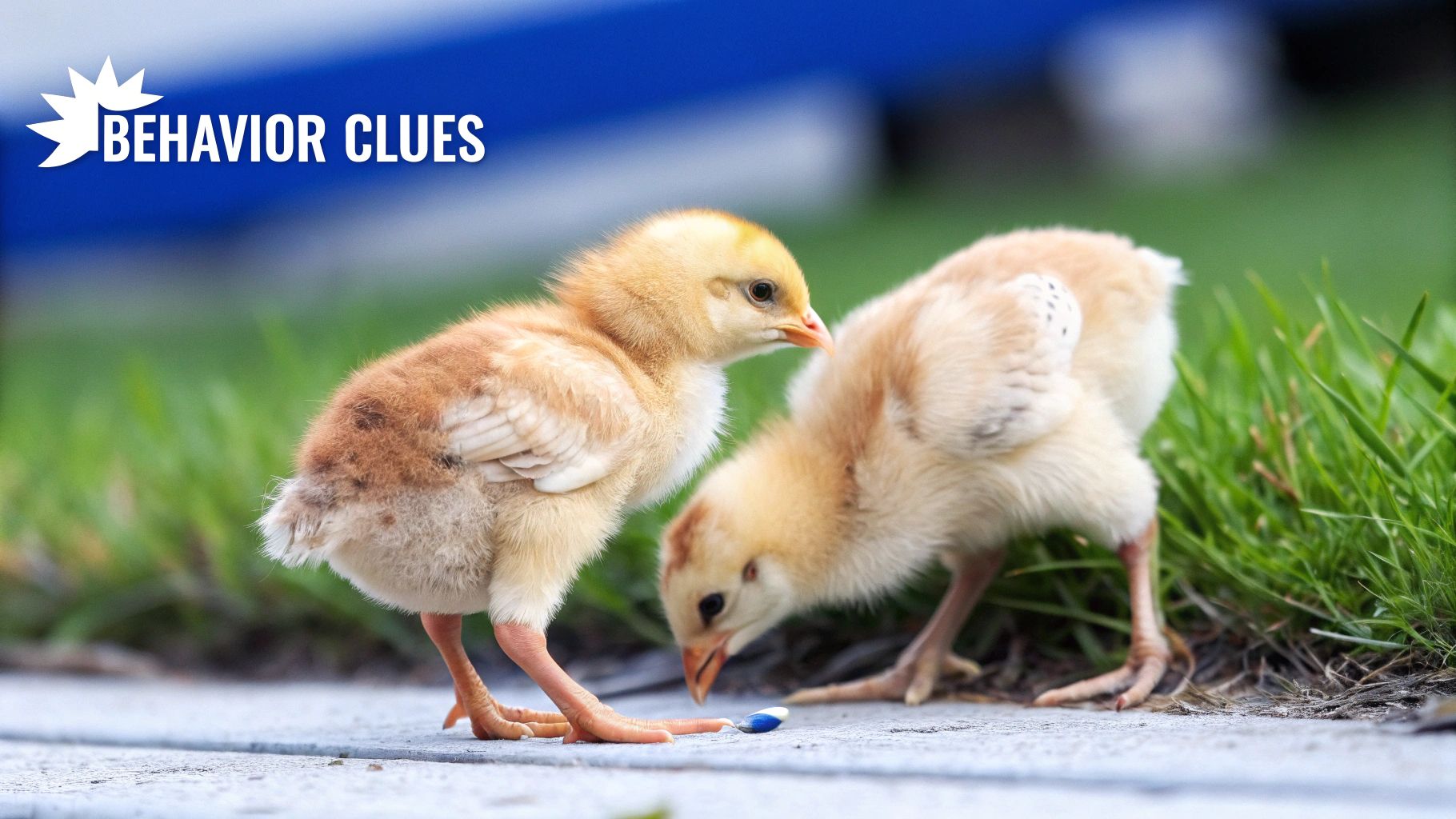
Sometimes, how they act is just as revealing as how they look. Young cockerels are often the braver, more confident ones in the group. You might catch them puffing out their chests and bumping into their siblings, or standing tall in what I call a “sergeant major” pose.
One of the most endearing—and surefire—signs is something called “tidbitting.” A young cockerel will find what he thinks is a delicious treat, pick it up and drop it over and over, all while making a special clucking sound to call the pullets over to share. It’s a classic courtship display you’ll almost never see a female do. And, of course, the moment you hear a strangled, squeaky attempt at a crow, you’ve found your boy!
Honestly, the whole journey of watching your flock grow is one of the best parts of keeping poultry, starting long before they even hatch. If you’re fascinated by those very early stages, you might enjoy our guide on when to candle chicken eggs to get a peek at life inside. Seeing them develop from an embryo all the way to a full-grown bird really gives you a deeper connection to your flock.
Sorting Fact From Fiction
When you’re first getting into sexing chickens, it’s all too easy to be led astray by old wives’ tales and common mistakes. Knowing what’s folklore and what’s fact is key to getting it right. Let’s clear the air on some of those persistent myths and slip-ups that trip up even seasoned keepers.
One of the most charming but completely useless myths is telling a chick’s sex by its egg shape. The old story says pointed eggs hatch cockerels while round ones give you pullets. The truth? Egg shape comes down to the individual hen’s anatomy and has zero correlation with the sex of the chick inside.
Then there’s the classic “wedding ring test,” where you dangle a ring on a string over a chick to see which way it swings. This is pure superstition, plain and simple. It’s far better to stick with things you can actually see and measure.
Common Errors Even Experienced Keepers Make
Beyond the folklore, there are plenty of practical mistakes that can catch you out. A big one is trying to use the right method on the wrong bird. For instance, trying to feather-sex a purebred like a Leghorn or Orpington just won’t work. That technique is only reliable for specific sex-link hybrids.
Another frequent error is assuming the biggest chick in the brood must be a cockerel. Growth rates can vary wildly because of genetics, when they hatched, or even how pushy they are at the feeder. A bigger bird isn’t always a male.
Key Takeaway: Never rely on a single trait. A young cockerel might be slow to colour up his comb, or a pullet might be unusually bold. Always look for a combination of at least two or three different signs before you make your final call.
Getting impatient is another major pitfall. While some signs start to show at six weeks, many breeds take 12 weeks or more to really show their differences. Patience is probably the most important tool you have.
Why a Patient and Holistic Approach Works Best
Ultimately, a patient, evidence-based approach will save you from making a rushed (and often wrong) decision about your flock. There’s nothing more frustrating than rehoming a bird you’re sure is a cockerel, only to realise your mistake weeks later.
It’s also crucial to combine your observations with good general flock management. A healthy, well-cared-for bird is far more likely to develop along a typical timeline, which makes identification much easier. For more on keeping your flock in top condition, you might find our guide on how to worm chickens helpful.
A calm, observant strategy, free from myths and snap judgments, will always give you the most accurate results in the long run. You won’t just get better at spotting your cockerels and pullets—you’ll gain a much deeper understanding of how your birds grow and develop.
Your Questions on Sexing Chickens Answered
Even after you’ve got the theory down, sexing chickens in the real world throws up all sorts of practical questions. I get it. It often feels like you’re trying to solve a puzzle, so it’s completely normal to have a few things you’re still not sure about.
Let’s walk through some of the most common questions I hear from fellow UK keepers. Hopefully, this will clear up any lingering confusion you might have.
I Bought ‘Sexed Pullets’ but One Is Crowing. What Happened?
Ah, the classic surprise cockerel. This is probably one of the most common frustrations for anyone keeping a small flock. You’ve paid a premium for guaranteed girls, only to be woken up by a rather pathetic, scratchy crow a few months down the line.
The simple truth is that even professional sexing isn’t a perfect science.
Most large commercial hatcheries will only claim 90-95% accuracy on their sexed chicks. What this really means is that for every 20 pullets you buy, there’s a pretty good statistical chance that one or even two will turn out to be cockerels. It doesn’t mean you’ve been sold a dud batch from a bad hatchery; it’s just the accepted margin of error for a difficult job that has to be done incredibly quickly.
Can a Hen Actually Crow?
Believe it or not, yes! While it’s certainly not common, a hen can and sometimes will crow. This odd behaviour usually pops up in flocks where there isn’t a cockerel. In his absence, a dominant hen might start taking on some male traits and behaviours to fill that top spot in the pecking order.
Her crow will typically sound different from a cockerel’s—often weaker, more raspy, and less confident. It’s a fascinating look into chicken flock dynamics, but it can definitely be confusing. If a bird you were certain was a pullet suddenly starts to crow, have a good look for other male signs, like the pointy saddle feathers developing, before you make a final call.
At What Age Can I Be 100% Certain of My Chicken’s Sex?
For absolute, no-questions-asked certainty, you’ll have to play the waiting game. You can make a very educated guess with most breeds by 12-16 weeks old, as secondary sex characteristics like saddle feathers and comb size become much more obvious.
But there are really only two definitive, undeniable signs:
- A cockerel perfecting his full-throated, unmistakable crow.
- A pullet laying her very first egg.
Until one of those two things happens, there’s always a tiny sliver of doubt. I’ve seen some slow-maturing cockerels fool experienced keepers for a surprisingly long time. This whole journey of watching them grow is a key part of the experience, and you can learn more about it by reading our guide on raising chickens from eggs.
Remember, every chicken develops at its own pace. Breed, nutrition, and individual genetics all play a role in how quickly a bird matures and shows its true colours. Comparing chicks from the same hatch is always your most reliable method for spotting differences early on.
Ultimately, sexing your flock is a mix of a little bit of science, a lot of careful observation, and a healthy dose of patience. By understanding these common pitfalls, you can approach the task with a lot more confidence and truly enjoy the process of getting to know your birds.
At HatchingEggs.eu, we provide premium, fertile hatching eggs from healthy, well-managed breeding stock to help you start your flock with confidence. Whether you’re a first-timer or an experienced breeder, explore our wide selection and hatch your dreams today at https://www.hatchingeggs.eu.